In short. Microsoft's November 2026 security updates, released on 10 November, fix nearly 1,100 vulnerabilities, 63 of them critical. One, in Outlook, is already being exploited, and critical flaws in domain controller LDAP and Exchange Server should be patched before anything else.
What happened
Outlook zero-day: CVE-2026-124194
It scores only 6.5 on CVSS, but Microsoft confirms it is being exploited. An attacker sends a crafted file; when the user opens it, Outlook connects to an attacker-controlled location without the usual warning and leaks the user's NTLMv2 password hash, which can be relayed to sign in as that user or cracked offline.
It affects Microsoft 365 Apps for Enterprise and Office LTSC 2021 and 2024. The US agency CISA has added it to its list of exploited vulnerabilities, with a federal patch deadline of 24 November 2026.
Flaws that need no login and no user action
- CVE-2026-119958, Windows LDAP: unauthenticated remote code execution that puts domain controllers and the whole of Active Directory at risk.
- CVE-2026-118207, Exchange Server: a code execution flaw that analysts say could be triggered by anyone able to email the organisation.
- Further critical flaws sit in Active Directory Domain Services, IIS and Windows Deployment Services.
Zero Day Initiative counts around 30 potentially wormable flaws, mostly in Message Queuing, DNS and DHCP Server.
Who is affected
- Organisations running on-premises Active Directory or their own domain controllers
- Organisations still running Exchange Server on their own servers
- Outlook users on Microsoft 365 Apps or Office LTSC
- Windows servers exposing IIS, DNS, DHCP or Message Queuing to other networks
If you only use Exchange Online, Microsoft patches the mail servers, but every machine with Outlook installed still needs updating.
What to do
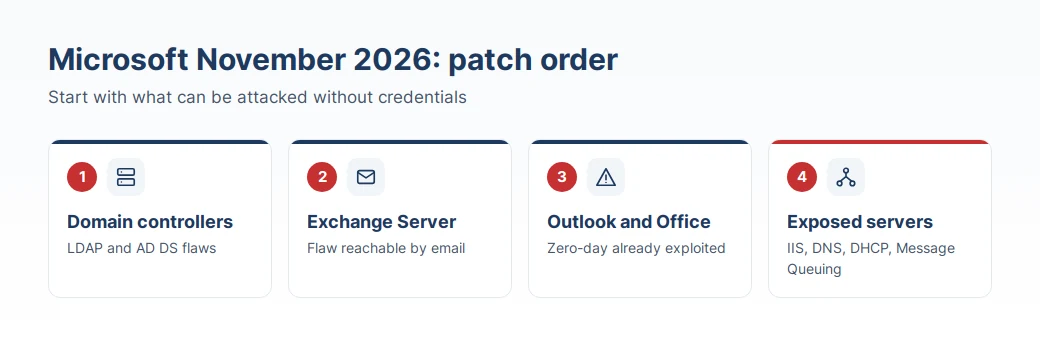
- Patch domain controllers and Exchange Server first, because they can be attacked without credentials.
- Update Outlook and Office on every machine, and check devices where automatic updates are switched off.
- Patch servers that expose services to other networks, such as IIS, DNS and DHCP, and disable Message Queuing where nothing uses it.
- Test patches on a test machine first if you have one, and confirm your latest backup restores before patching critical servers, especially domain controllers.
- Consider restricting NTLM and blocking outbound SMB to the internet to reduce exposure to this kind of hash theft in future.
If your IT team would like help planning the patch order or checking that backups are ready before patching, J.A.I Solution can help. Get in touch through our website.
Sources
- Qualys, Microsoft Patch Tuesday November 2026 Security Update Review (10 November 2026)
- CSO Online, November 2026 Patch Tuesday: 63 critical Microsoft fixes plus an Outlook zero-day
- Security Affairs, Microsoft November Patch Tuesday: one exploited Outlook bug and 30 wormable flaws
Note: sources give slightly different totals, so figures are approximate.